

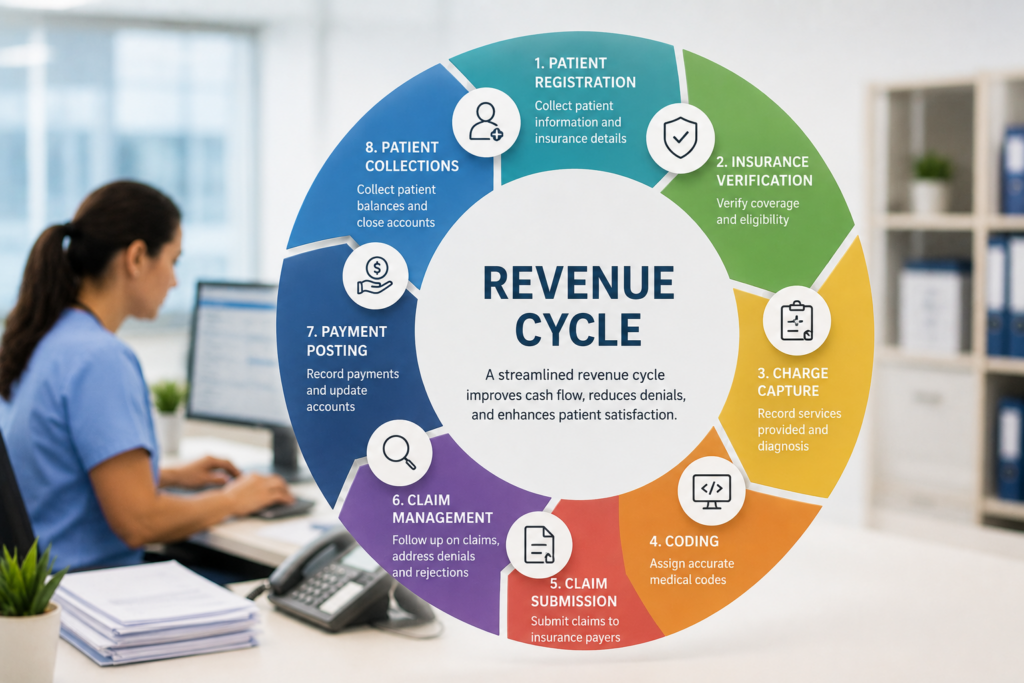
Healthcare revenue cycle modernization is becoming one of the most important operational priorities in healthcare. Providers, laboratories, and healthcare-adjacent companies are facing more billing complexity, reimbursement pressure, staffing constraints, documentation requirements, and cybersecurity risk.
At the same time, AI and automation are moving from experimental tools into practical operating infrastructure. Recent healthcare revenue cycle management trends show that providers are under pressure to modernize billing workflows, improve claim quality, reduce administrative friction, and strengthen revenue visibility.
For private equity and strategic operators, this creates a clear value creation opportunity. Healthcare companies that can modernize revenue cycle operations may improve cash flow, reduce leakage, strengthen compliance, and build more scalable operating infrastructure.
Why Healthcare Revenue Cycle Modernization Matters Now
Healthcare revenue cycle modernization matters because the revenue cycle is no longer just a back-office billing function. It directly affects financial performance, operational stability, patient experience, and long-term enterprise value.
Revenue cycle management begins before care is delivered and continues through eligibility checks, documentation, coding, claim submission, denial management, collections, payment posting, and reporting. When these workflows are fragmented or manual, problems can compound quickly.
Industry reporting for 2026 points to AI-powered automation, rising cyberthreats, and hybrid operating models as major revenue cycle management trends. Providers are under pressure to improve efficiency while managing workforce shortages and increasingly complex reimbursement models.
AI Is Becoming a Practical Revenue Cycle Tool
AI is now being applied to real revenue cycle problems. These include denial prediction, coding support, documentation review, claim prioritization, appeal preparation, and operational reporting.
The value is not in replacing revenue cycle teams. The value is in reducing manual work, identifying risk earlier, and helping teams focus on the claims and documentation issues that require attention.
For healthcare and laboratory businesses, AI can help organize unstructured documentation, surface coding inconsistencies, prioritize high-risk claims before submission, and improve claim quality at scale. This is especially relevant for companies with high claim volume or complex billing workflows.
Denials and Documentation Gaps Create Financial Pressure
Claim denials remain one of the clearest examples of revenue cycle friction. A denied claim does not only delay payment. It adds administrative work, increases follow-up costs, and can expose weaknesses in documentation, coding, payer rules, or internal workflows.
Modern revenue cycle systems can help identify denial patterns earlier. They can also help management understand whether problems are tied to payer behavior, documentation quality, coding accuracy, eligibility verification, or workflow breakdowns.
This visibility is important because revenue cycle improvement depends on root-cause analysis. Without better reporting, teams may spend time fixing individual claims while missing the broader operational issue.
Cybersecurity Is Now Part of Healthcare Operations
Healthcare revenue cycle modernization cannot ignore cybersecurity. Healthcare companies manage sensitive patient data, financial records, claims information, and operational systems. As more workflows become digital, cyber risk becomes part of the operating model.
Modernization should include stronger access controls, system governance, data protection, vendor review, backup procedures, and incident preparedness. A revenue cycle system is not only a financial tool. It is also part of the company’s compliance and risk infrastructure.
This matters for investors because cyber weakness can affect diligence, transaction risk, operational continuity, and enterprise value.
Private Equity Is Paying Attention to Healthcare Infrastructure
Private equity and strategic buyers are increasingly focused on healthcare infrastructure, healthcare IT, diagnostics, revenue cycle tools, and service platforms with recurring or mission-critical demand.
Recent market activity shows continued interest in healthcare diagnostics and technology-enabled healthcare services. For example, Reuters reported that Jardine Matheson agreed to acquire I-MED Radiology Network, a large medical imaging provider with operations across Australia and New Zealand and a minority stake in AI radiology company Harrison.ai.
This type of activity reinforces a broader point: healthcare platforms with operational scale, data infrastructure, diagnostic relevance, and technology modernization potential remain strategically important.
Revenue Cycle Modernization Supports Better Management Visibility
Healthcare operators need reliable visibility into financial and operational performance. That includes claim status, denial trends, payment timing, payer mix, documentation gaps, coding issues, accounts receivable, workflow volume, and collection performance.
Without strong reporting, leadership may not see revenue leakage until it has already created cash flow pressure. Better reporting allows management teams to act earlier, prioritize resources, and improve accountability.
For private equity-backed healthcare companies, reporting is also central to value creation. Investors and operators need to understand whether modernization efforts are improving performance over time.
Operational Infrastructure Matters More Than Software Alone
Buying new revenue cycle software does not automatically solve revenue cycle problems. The business also needs clean workflows, trained teams, reliable documentation, clear ownership, and management discipline.
The best modernization efforts usually start with process mapping. Leaders need to understand where information enters the system, where claims get delayed, where documentation gaps appear, and where manual work creates avoidable friction.
Once the process is clear, technology can be applied more effectively.
What This Means for Healthcare and Laboratory Businesses
For healthcare and laboratory businesses, revenue cycle modernization can support stronger cash flow, fewer avoidable denials, better compliance visibility, and more scalable operations.
Laboratory and diagnostic companies often deal with high-volume workflows, documentation requirements, payer complexity, and operational handoffs. If these systems are not modernized, growth can create more administrative burden instead of more enterprise value.
Companies with strong clinical or service demand but underdeveloped revenue cycle infrastructure may have meaningful modernization potential.
WASSWA Capital’s Perspective
At WASSWA Capital, we view healthcare revenue cycle modernization as part of a broader operating transformation. Our focus is private equity for technology-driven transformation, especially where better systems, data infrastructure, automation, and reporting can strengthen business performance.
Healthcare businesses do not need technology for its own sake. They need systems that reduce friction, improve visibility, support compliance, and allow the business to scale with more discipline.
As healthcare operations become more complex, revenue cycle modernization will become increasingly important to long-term enterprise value creation.
For more insights on healthcare operations, AI infrastructure, acquisition strategy, and private equity value creation, visit the WASSWA Capital Insights page.
Frequently Asked Questions
What is healthcare revenue cycle modernization?
Healthcare revenue cycle modernization is the process of improving billing, documentation, coding, claims, denial management, payment tracking, reporting, and revenue operations through better systems, workflows, automation, and data visibility.
Why does revenue cycle modernization matter for healthcare companies?
It matters because revenue cycle performance directly affects cash flow, operating efficiency, claim quality, compliance visibility, and financial stability.
How can AI help healthcare revenue cycle operations?
AI can help with denial prediction, documentation review, coding support, claim prioritization, reporting summaries, appeal workflows, and identification of operational patterns that need management attention.
Why is healthcare revenue cycle important to private equity?
Revenue cycle performance is important to private equity because it affects cash flow, scalability, operating discipline, risk management, and long-term enterprise value creation.