

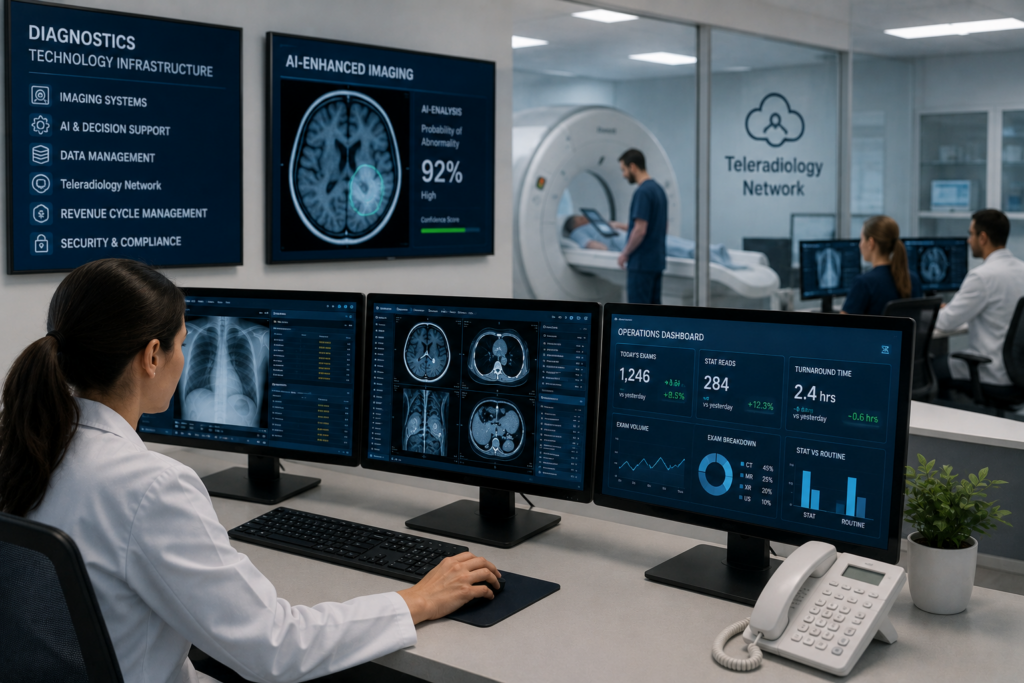
Healthcare Diagnostics Is Becoming a Technology Infrastructure Play
Healthcare diagnostics technology infrastructure is becoming increasingly important as healthcare systems, investors, and operators look for businesses that combine clinical demand with scalable operating systems.
Recent market activity shows this shift clearly. Reuters reported that Jardine Matheson agreed to acquire I-MED Radiology Network, a major medical imaging provider, for an enterprise value of approximately $2.4 billion. I-MED operates hundreds of imaging clinics across Australia and New Zealand, performs millions of procedures annually, and also has a minority stake in AI radiology company Harrison.ai.
For private equity and long-term investors, the message is clear: healthcare diagnostics is no longer only about clinical service delivery. It is also about technology infrastructure, data workflows, AI enablement, operational scale, and reporting visibility.
Why Healthcare Diagnostics Technology Infrastructure Matters
Healthcare diagnostics technology infrastructure matters because diagnostic businesses are complex operating platforms. Imaging centers, laboratories, and diagnostic service providers handle patient intake, scheduling, documentation, testing, clinical review, billing, reporting, compliance, and data management.
When these workflows are fragmented, growth becomes difficult. More volume can create more complexity, more delays, more administrative burden, and greater compliance risk.
Strong technology infrastructure helps diagnostic businesses manage volume with greater consistency, visibility, and scalability.
Diagnostics Is a High-Volume Data Business
Healthcare diagnostics produces and manages large amounts of information. Imaging files, laboratory results, patient records, physician referrals, billing data, insurance details, clinical notes, and operational reports all need to move through the business accurately.
This makes diagnostics a natural category for technology-driven modernization. Better systems can improve turnaround times, reduce administrative friction, strengthen reporting, and support better coordination between clinical and operational teams.
For investors, this data intensity can be both a challenge and an opportunity.
AI Is Becoming More Relevant in Diagnostic Workflows
AI is becoming more relevant in healthcare diagnostics because imaging and laboratory operations involve repeatable, data-heavy workflows. In radiology, AI can support image review, workflow prioritization, quality control, and operational efficiency.
The I-MED transaction is notable because I-MED has exposure to AI radiology through its minority stake in Harrison.ai. That does not mean AI replaces clinicians. It shows that diagnostic platforms with AI adjacency may be strategically valuable as healthcare operators look for ways to improve efficiency and scale.
The strongest AI use cases in diagnostics will still require clinical oversight, compliance discipline, and responsible governance.
Teleradiology Shows the Importance of Scalable Operations
Teleradiology is another reason diagnostics increasingly depends on infrastructure. When imaging review can extend across regions, time zones, or service networks, the operating system must support secure data transfer, workflow routing, reporting, and quality control.
Reuters noted that I-MED offers teleradiology services across Australia, New Zealand, and the United States. This kind of model requires operational discipline and technology-enabled coordination.
For diagnostic businesses, scale is not just about opening more locations. It is about building systems that allow the organization to manage complexity across the network.
Private Equity and Strategic Buyers Are Watching Healthcare Infrastructure
Healthcare diagnostics remains attractive because it sits at the intersection of clinical necessity, recurring demand, data intensity, and operational complexity. These traits can make the category appealing to strategic buyers and investment firms.
The Jardine-I-MED transaction also reflects interest in healthcare platforms with established market positions and growth potential. Reuters reported that I-MED performs more than 7 million procedures annually and operates across Australia and New Zealand, showing meaningful platform scale.
For WASSWA Capital, this type of market activity reinforces the importance of operational modernization in healthcare-adjacent businesses.
Revenue Cycle and Billing Infrastructure Still Matter
Diagnostics businesses also depend heavily on billing and revenue cycle infrastructure. Imaging, laboratory testing, payer requirements, coding, documentation, and claim submission can all create financial friction if systems are weak.
Modern billing infrastructure helps improve visibility into claims, denials, payment timing, documentation gaps, and payer trends. Without that visibility, revenue leakage can be difficult to detect and correct.
As diagnostic businesses scale, revenue cycle modernization becomes more important to enterprise value.
What This Means for Lower-Middle-Market Healthcare Companies
Lower-middle-market healthcare and laboratory businesses may not operate at the scale of I-MED, but the same themes still matter. Strong demand alone is not enough. Businesses need systems that can support documentation, billing, compliance, reporting, workflow management, and data visibility.
Companies with strong service demand but underdeveloped infrastructure may have meaningful modernization potential. This is especially true when the business has repeatable workflows, fragmented systems, or manual administrative processes.
Operational gaps can become value creation opportunities when paired with the right technology and execution strategy.
WASSWA Capital’s Perspective
At WASSWA Capital, we view healthcare diagnostics as part of a broader technology-driven transformation theme. Diagnostics, laboratory services, healthcare operations, and tech-enabled services often depend on strong infrastructure to scale effectively.
Our focus is private equity for technology-driven transformation. We look for businesses where better systems, automation, reporting, AI-enabled workflows, and operational discipline can improve long-term enterprise value.
Healthcare diagnostics is becoming a technology infrastructure play because the future of the category depends not only on clinical demand, but also on how well businesses manage data, workflows, revenue cycle, compliance, and scale.
For more insights on healthcare operations, acquisition strategy, AI infrastructure, and long-term enterprise value creation, visit the WASSWA Capital Insights page.
Frequently Asked Questions
Why is healthcare diagnostics becoming a technology infrastructure play?
Healthcare diagnostics depends on high-volume workflows, imaging or lab data, scheduling, documentation, billing, reporting, compliance, and secure data management. Strong technology infrastructure helps these businesses scale more effectively.
How does AI affect healthcare diagnostics?
AI can support diagnostic workflows by helping with image review support, workflow prioritization, quality control, reporting assistance, and operational efficiency, while still requiring clinical oversight.
Why do investors care about healthcare diagnostics?
Investors may care about healthcare diagnostics because the category has recurring demand, data intensity, operational complexity, platform potential, and opportunities for technology-driven modernization.
What makes a diagnostic business scalable?
A scalable diagnostic business usually has strong workflow systems, reliable reporting, revenue cycle visibility, compliance infrastructure, data management, leadership depth, and the ability to manage volume across locations or service lines.