

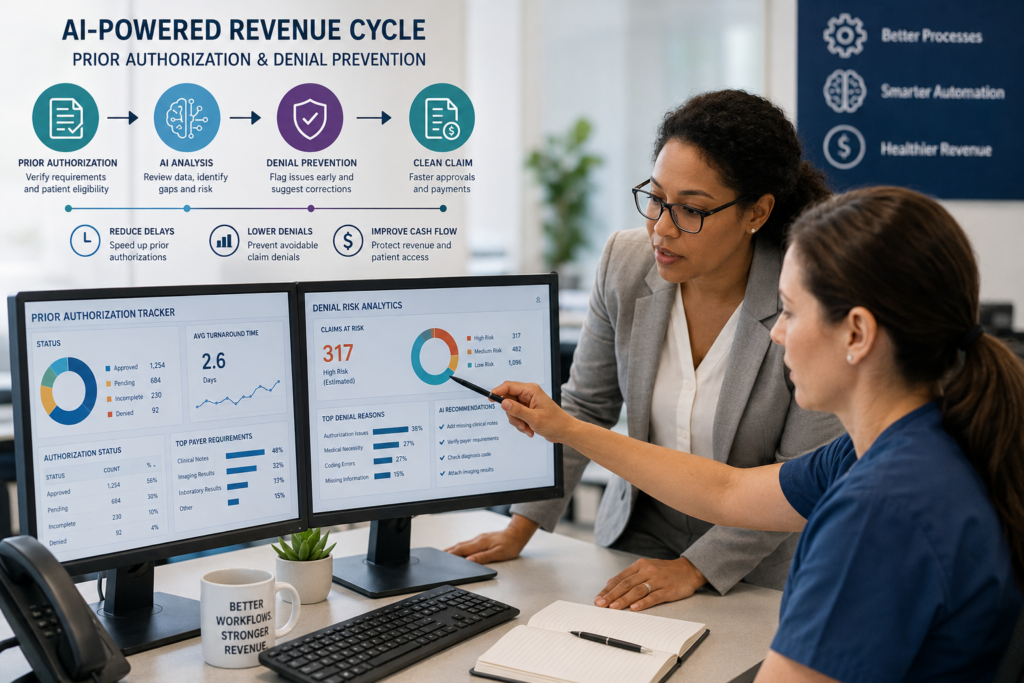
AI prior authorization and denial prevention are becoming serious operational priorities in healthcare. Providers are dealing with payer delays, complex documentation requirements, claim denials, staffing pressure, and rising administrative workload.
This is not only a technology story. It is a healthcare operations story. Revenue cycle teams need faster ways to identify risk, organize documentation, manage payer requirements, and prevent avoidable delays before they affect cash flow.
Recent healthcare finance reporting shows that revenue cycle leaders are increasingly looking to AI for automation across patient engagement, prior authorization, and denial prevention. This reflects a broader shift in healthcare: administrative workflows are becoming just as important to financial performance as clinical demand.
Why AI Prior Authorization and Denial Prevention Matter
AI prior authorization and denial prevention matter because small workflow failures can create major financial consequences. A missing document, incorrect code, delayed authorization, or incomplete eligibility check can slow reimbursement and increase administrative cost.
For healthcare providers, laboratories, imaging centers, and diagnostic businesses, these issues can occur at high volume. When the process is manual, teams may not catch problems until after a claim is delayed or denied.
AI-supported workflows can help identify risk earlier and give teams a better chance to resolve problems before they become revenue leakage.
Prior Authorization Is an Operational Bottleneck
Prior authorization is one of the clearest examples of healthcare administrative friction. It requires coordination between providers, payers, documentation, clinical information, and scheduling workflows.
When authorization is delayed, care can be delayed. Billing can also be delayed. Staff may spend significant time checking payer portals, calling insurers, resubmitting documentation, and tracking approval status.
AI and automation can support this process by organizing requirements, flagging missing information, routing tasks, and helping teams prioritize cases that need attention.
Denial Prevention Starts Before Claim Submission
Denial management is often treated as a back-end problem, but many denials begin earlier in the workflow. Eligibility issues, missing documentation, coding mismatches, authorization gaps, and payer-specific requirements can all create denial risk before a claim is submitted.
This is why denial prevention is more valuable than denial response. A healthcare organization that can identify high-risk claims earlier can reduce rework, improve cash flow, and lower administrative burden.
AI can help by reviewing claim patterns, surfacing exceptions, and identifying cases that may need human review before submission.
Revenue Cycle Teams Need Better Work Queues
One practical use of AI is smarter work queue management. Revenue cycle teams often face large volumes of tasks. Not every claim or authorization request carries the same risk or financial impact.
AI-supported systems can help prioritize work based on payer behavior, dollar value, denial history, missing information, or urgency. This helps teams focus attention where it matters most.
For operators, this is important because better prioritization can improve productivity without simply adding more staff.
Clean Data Still Comes First
AI cannot fix a broken data environment on its own. Prior authorization and denial prevention depend on accurate patient information, payer rules, coding data, documentation, claim history, and workflow status.
If the underlying data is incomplete or scattered, AI outputs may be unreliable. Healthcare businesses need disciplined data infrastructure before automation can produce consistent results.
This is why healthcare modernization should start with process clarity, documentation standards, data cleanup, and ownership of key workflows.
Human Oversight Remains Essential
AI can support healthcare revenue cycle operations, but it should not remove human accountability. Prior authorization and denial prevention involve payer rules, clinical documentation, compliance considerations, and patient impact.
Human teams still need to review exceptions, validate recommendations, handle complex cases, and manage payer communication.
The strongest model is not AI replacing staff. It is AI helping staff work faster, with better visibility and fewer avoidable errors.
What This Means for Healthcare and Laboratory Businesses
Healthcare and laboratory businesses with high claim volume, documentation complexity, or payer friction may benefit from AI-supported revenue cycle modernization.
For laboratories, diagnostic providers, and healthcare-adjacent service businesses, reimbursement depends on clean documentation, accurate coding, payer compliance, and timely follow-up. Weakness in any part of that workflow can affect financial performance.
Businesses that build better authorization, billing, and denial prevention infrastructure may become more scalable and more attractive to long-term operators and investors.
WASSWA Capital’s Perspective
At WASSWA Capital, we view revenue cycle modernization as part of technology-driven transformation in healthcare operations.
The opportunity is not simply to add AI tools. The opportunity is to strengthen the operating system behind the business: documentation, workflows, reporting, data quality, task routing, and accountability.
AI prior authorization and denial prevention show how healthcare value creation is becoming more operational, more data-driven, and more infrastructure-dependent.
For more insights on healthcare operations, AI strategy, acquisition strategy, and private equity value creation, visit the WASSWA Capital Insights page.
Frequently Asked Questions
How can AI help with prior authorization?
AI can help with prior authorization by organizing payer requirements, flagging missing documentation, routing tasks, monitoring authorization status, and helping teams prioritize cases that need attention.
How can AI reduce claim denials?
AI can reduce claim denials by identifying high-risk claims before submission, detecting documentation gaps, reviewing historical denial patterns, and surfacing payer-specific issues for human review.
Does AI replace revenue cycle staff?
No. AI should support revenue cycle staff by reducing manual work, improving visibility, and helping teams focus on complex or high-risk cases. Human oversight remains essential.
Why does this matter to private equity?
Prior authorization and denial prevention matter to private equity because they affect cash flow, operating efficiency, scalability, and long-term enterprise value in healthcare businesses.